City & Region
In a nutshell
Geneva is a city and a canton at the western end of Lake Geneva, the Léman, where Switzerland meets France. It is small, but it hosts some of the world’s most important international organisations and one of its largest laboratories.
This page covers the three fields that put Geneva on the map of science, the city’s relationship with water and its place on the TheScience.fm Atlas.
2Particle physics in Geneva: CERN
CERN, Europe’s laboratory for particle physics, has two main sites, in Switzerland and in France, near the Franco-Swiss border next to Geneva. Its visitor centre, Science Gateway, opened to the public in October 2023. The laboratory’s largest machine, the Large Hadron Collider, is a 27-kilometre ring that runs underground on both sides of the border. More in Science.
3Astronomy in Geneva: a planet around a sun-like star
In 1995 Michel Mayor and Didier Queloz of the University of Geneva announced 51 Pegasi b, the first planet found orbiting a star like the Sun; planets around a pulsar had been reported in 1992. The 2019 Nobel Prize in Physics recognised the discovery of an exoplanet orbiting a solar-type star. More in Discoveries.
4Standards in Geneva: ISO, IEC and ITU
Three of the organisations that write the world’s technical standards have their headquarters in Geneva: ISO since 1947, and IEC and ITU since 1948. More in Science and in the article Who writes the world’s technical standards?
5A canton of water
The canton calls itself “a canton of water”. Its part of Lake Geneva is only about 6 % of the lake’s surface, yet the lake, its beaches and its rivers shape the landscape. In 2025 the canton received the Wetland City label of the Ramsar Convention on Wetlands.
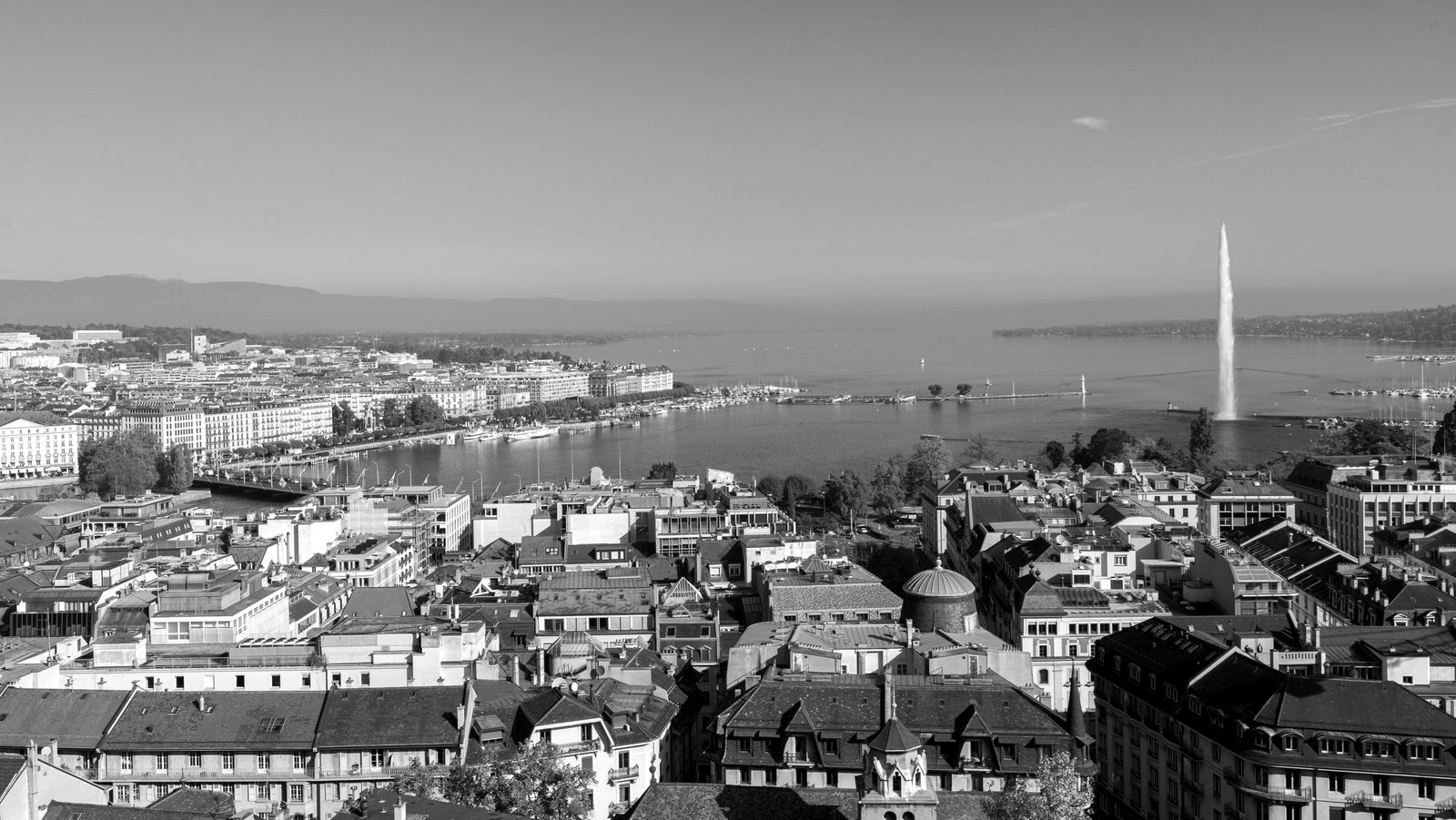
The city’s symbol, the Jet d’eau, began as a piece of engineering. In 1886 an outlet was built at the Coulouvrenière pumping station to release excess pressure from the city’s pressurised water network, producing a vertical jet. In 1891 the city moved the jet to the harbour, at the end of the Eaux-Vives jetty. Today it rises about 140 metres, with water leaving the nozzle at about 200 km/h.
6A city of parks and plants
Geneva is known as the “city of parks”, and its interest in plants is old: the city traces its botanical tradition back more than 300 years. In 1817 the authorities created a permanent botanical garden under Augustin-Pyramus de Candolle; today’s Conservatory and Botanical Garden holds a herbarium of more than six million specimens.
Every spring the city watches one tree. The day the first leaf unfolds on the official chestnut tree of the Treille is recorded and used to announce spring; the official series of dates goes back to 1818. More in Discoveries.
7International Geneva in the city
International Geneva is part of the cityscape. The Palais des Nations stands in the Ariana Park, which Gustave Revilliod left to the City of Geneva in 1890, and the building was begun in 1929 for the League of Nations. How the organisations, missions and NGOs work together is explained in Diplomacy.
8Geneva on the Atlas
Geneva lies on two routes of the TheScience.fm Atlas: Big Machines, which links large research machines for particles, photons and plasma, and Swiss Model, which shows how Switzerland organises research.
-
Big Machines via Geneva
Large research machines for particles, photons and plasma.
Stops: Grenoble.science → Geneva.science → Lausanne.science → Villigen.science → Frascati.science
-
Space agencies, mission centres and the people who build spacecraft.
Stops: Pasadena.science → Noordwijk.science → Bonn.science → Frascati.science
-
Cities tied to ideas about how science is judged, funded and measured. Frascati gave its name to the rules for counting R&D.
Stops: Sevres.science → Lyon.science → Bonn.science → Bologna.science → Frascati.science
-
Swiss Model via Geneva
How Switzerland organises research, from CERN's host city to its federal institutes.
Stops: Geneva.science → Lausanne.science → Villigen.science → Zuerich.science
All hubs
| Hub | Anchor institutions | Routes |
|---|---|---|
| Bologna.science | Bologna Process · ECMWF data centre | Concept Cities |
| Bonn.science | DFG · DAAD · Humboldt Foundation · German Space Agency at DLR | Space, Concept Cities |
| Frascati.science | INFN-LNF · ESA ESRIN · ENEA | Big Machines, Space, Concept Cities |
| Geneva.science | CERN | Big Machines, Swiss Model |
| Grenoble.science | ESRF · ILL | Big Machines |
| Lausanne.science | EPFL Swiss Plasma Center | Big Machines, Swiss Model |
| Lyon.science | IARC, the WHO cancer research agency | Concept Cities |
| Noordwijk.science | ESA ESTEC | Space |
| Pasadena.science | Caltech · NASA JPL | Space |
| Sevres.science | BIPM · SI and metrology | Concept Cities |
| Villigen.science | Paul Scherrer Institute | Big Machines, Swiss Model |
| Zuerich.science | ETH Zurich | Swiss Model |
| science.Taipei | Academia Sinica | — |
Sources
- République et canton de Genève, Genève, un canton d’eau, checked 29 October 2026
- République et canton de Genève, Le patrimoine aquatique local du canton de Genève récompensé par le label de la Convention Ramsar, checked 29 October 2026
- Ville de Genève, Jet d’eau de Genève, checked 29 October 2026
- CERN, Directions, checked 29 October 2026
- CERN, CERN inaugurates Science Gateway, its new outreach centre for science education, checked 29 October 2026
- University of Geneva, Physics Section, The 2019 Nobel Prize in Physics awarded to Michel Mayor and Didier Queloz, checked 29 October 2026
- Nobel Prize Outreach, Press release: The Nobel Prize in Physics 2019, checked 29 October 2026
- A. Wolszczan, D. A. Frail, A planetary system around the millisecond pulsar PSR1257+12, Nature 355, 145–147 (1992), checked 29 October 2026
- République et canton de Genève, Grand Conseil, Marronnier officiel, checked 29 October 2026
- Swiss Association for Standardization (SNV), 100 years of SNV: the decade 1940–1950, checked 29 October 2026
- IEC, How and why the IEC was started, checked 29 October 2026
- ITU, Overview of ITU’s history, checked 29 October 2026
- Ville de Genève, La botanique genevoise, une tradition vieille de plus de 300 ans, checked 29 October 2026
- United Nations Office at Geneva, Palais des Nations history, checked 29 October 2026
- CERN, The Large Hadron Collider, checked 29 October 2026