Watchmaking: the Geneva Seal and the craft of precision
In a nutshell
A mechanical watch is a small machine that keeps time with springs and gears. Geneva has made them for centuries, and since 1886 the canton has offered a public guarantee of quality and origin for watches made here: the Geneva Seal, or Poinçon de Genève.
In 2020 the craftsmanship of mechanical watchmaking and art mechanics of Switzerland and France was added to UNESCO’s list of the intangible cultural heritage of humanity.
2The Geneva Seal
The Geneva Seal rests on a law. In 1886 the Canton of Geneva adopted a law on the voluntary testing of watches (the proposal is dated 6 November 1886), and rules of 26 March 1887 set out how the inspection office would work. The law was updated in December 2008.
Today the State of Geneva delegates the Poinçon de Genève office to TIMELAB, the Geneva laboratory of horology and microengineering. To receive the seal, a watch must be made and assembled in the canton of Geneva by a Geneva-based manufacturer. Since 2012 the seal has covered the finished, cased mechanical watch, not only its movement. The tests include water resistance (at least 3 bar), a power reserve no shorter than the maker states, a check of every function and a precision test over seven consecutive days, after which the watch may be off by no more than one minute.
A watch that passes receives the stamp visibly on a part of the movement, such as the plate or a bridge, and also on the case. It is a guarantee of origin and of quality.
3The Seal and the chronometer
The Geneva Seal is often confused with another Swiss mark, the chronometer certificate. A chronometer is a high-precision watch whose accuracy has been certified by a neutral official body. In Switzerland that body is COSC, the Official Swiss Chronometer Testing Institute, a non-profit association founded in 1973.
COSC tests mechanical movements according to the international standard ISO 3159: over about two weeks, in five positions and at three temperatures (8 °C, 23 °C and 38 °C). The watch’s average daily rate must stay between −4 and +6 seconds. The Geneva Seal answers a different question – not only how well a watch keeps time, but where and how it was made.
4Why watches came to Geneva
Swiss watchmaking took shape at the end of the 16th century, when French refugees arriving in the canton of Geneva brought skills in watchmaking and goldsmithing, and production turned towards small watches. Over time Geneva specialised in finishing and selling, while the making of movements spread across the Jura Arc.
By around 1785, according to the Swiss government’s presentation of the craft, some 20 000 people worked in watchmaking in Geneva, producing about 85 000 watches a year.
The craft is still taught here. The Geneva School of Watchmaking, part of the canton’s Centre for Technical Vocational Training (CFPT), has two centuries of history; in November 2023 it moved into new premises in Plan-les-Ouates.
5How a mechanical watch keeps time
Every clock needs something that swings at a steady rate and something that counts the swings. In a pendulum clock, the swinging part is the pendulum. The escapement connects it to the gears: a toothed escape wheel is held and released by a pallet, so that it advances by one tooth with each swing and gives the pendulum a small push. Christiaan Huygens made the first pendulum clock in 1656; its error was less than a minute a day.
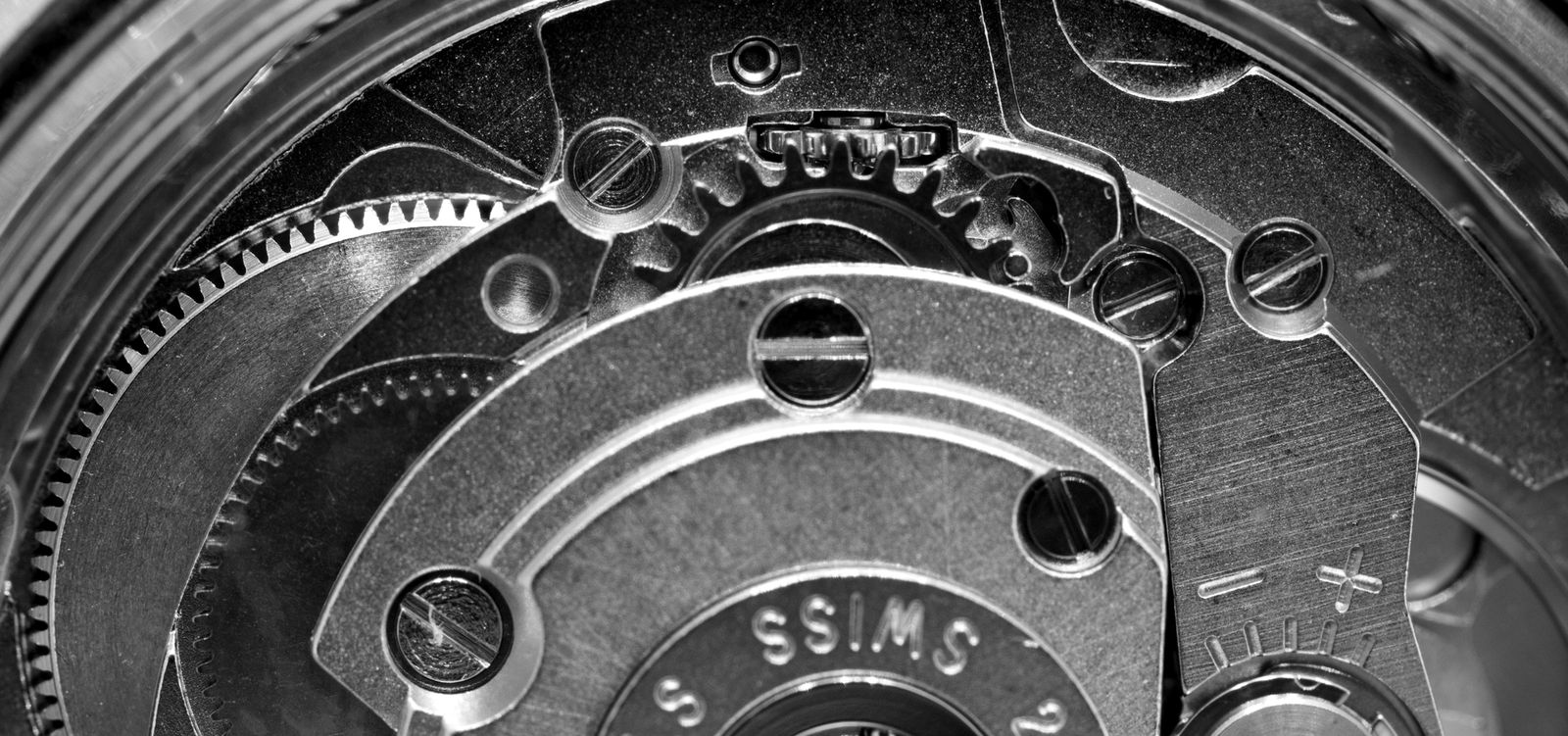
A watch cannot carry a pendulum. Watches already had a balance, a small wheel that turns back and forth, but without a spring its rate depended heavily on the driving force. Around 1675 Huygens developed the balance wheel and spring assembly, in which a fine spiral spring gives the balance its own steady period. Mechanical watches still work this way: a mainspring stores the energy, gears pass it on, the escapement releases it in small regular steps, and the balance and its spring set the rhythm.
Accuracy grew slowly. Even with the new spring, portable watches of the late 17th century could be off by about ten minutes a day; a precision pendulum clock made by Siegmund Riefler in 1889 kept time to about a hundredth of a second a day. Quartz clocks did better because they had no gears or escapements to disturb their frequency – and atomic clocks better still.
6A living heritage
On 16 December 2020 UNESCO inscribed the craftsmanship of mechanical watchmaking and art mechanics on its list of the intangible cultural heritage of humanity, as a joint, binational element of Switzerland and France. Art mechanics covers the making of automatons and music boxes.
7Precision, measured
A watch is a measuring instrument: it counts seconds. The second it counts is defined today by a fixed frequency of the caesium-133 atom. The world’s reference time, UTC, is computed after the fact from some hundreds of atomic clocks by the International Bureau of Weights and Measures in Sèvres, near Paris; national laboratories keep real-time approximations of it, which is what reaches our phones and radio clocks. Our sister site explains how world time is made.
The history of Geneva watchmaking can be seen in the city’s Musée d’art et d’histoire, whose collections include Geneva watches; see Science Travel.
8A note on brands
This section is about the craft and the public rules that govern it, not about particular companies. We do not promote watch brands and we do not publish sponsored content without labelling it as such.
Official texts
This page explains in our own words. For authoritative wording, always use the official documents linked in the sources.
Sources
- Poinçon de Genève, State guarantee, checked 29 October 2026
- Poinçon de Genève, Règlement du Poinçon de Genève (v1.1), checked 29 October 2026
- Federal Office of Culture (FOC), Craftsmanship of mechanical watchmaking and art mechanics, checked 29 October 2026
- BIPM, Time Department: UTC and Circular T, checked 29 October 2026
- Sevres.science, What is UTC? How world time is made, checked 29 October 2026
- Musée d’art et d’histoire de Genève, collection record: Montre de col primitive, à sonnerie et à tact, checked 29 October 2026
- COSC – Official Swiss Chronometer Testing Institute, FAQ, checked 29 October 2026
- aboutswitzerland.org (FDFA), The Swiss artisans of time, checked 29 October 2026
- République et canton de Genève, L’École d’horlogerie de Genève s’installe dans son nouvel écrin, checked 29 October 2026
- NIST, A Walk Through Time: A Revolution in Timekeeping, checked 29 October 2026